Un bloc de Brian Cutts amb música, llibres i algun que altre comentari sobre les Terres de l’Ebre o l’actualitat ..... music, books and the odd comment on current affairs, or local news and events in southern Catalonia.
Finally giving in to public demand, here's a few lines on Tortosa - where I live - for my international followers!
Basically, this is not the typical place where English migrants end up. No English supermarkets, no Marmite, no John Smiths beer, no groups of "Brits" gathered round SKY TV channels in noisy bars watching Premier League teams. Nor is it the other extreme, the dream-home for the English-man "gone local" who spends his time caring for chickens and olive groves before playing his guitar out on the verandah on a moonlit night. No, it's just a normal town with normal people.
Wikipedia says it all, but basically; a reasonably-sized town in the south of Catalonia with a population of about 35,000 inhabitants.The main feature is the river Ebro, which winds its way through town on its way to the Mediterranean.
It is the largest town in this area, though, and, as such, has a plethora of shops, services, and public bodies, making it a pretty important place for people around here. It has its old part, with Renaissance period buildings and a castle built originally by the Moors. At different moments in history it has been an important town in Catalonia, and the trilogy of Moors, Jews, and Christians have all left their mark on the town's history and culture. However, its days of splendour are long gone as all the real action in Catalonia happens up near Barcelona or further north, and the economic crisis has also taken its toll. Most youngsters have to leave to find work or if they want to go to university. There is very little industry, and most of the local economy is probably based on the above-mentioned service industries as well as agriculture (which isn't exactly blooming) and a sort of green-sustainable-tourism thanks to its location. In more recent history, Tortosa was the focal point for the tragic Battle of the Ebro which more or less culminated Franco's coup back in the 1930s' Spanish Civil War. The town was bombed out of recognition and thousands of lives were futilely lost in months of trench warfare.
We are only a 30-minute drive from the El Port mountain chain - with peaks higher than any mountain in Great Britain - or 30 minutes from the spectacular Ebro Delta with amazing wildlife, unique landscapes, and miles of wind-swept tourist-free beaches.
Tortosa suits me - big enough to have a fair share of things to do, near enough to Barcelona in case I ever want to see The City, but small enough to more or less know everyone and live a peaceful small-town life.
Maybe a few photos will give a clearer idea....
And the afore-mentioned Ebro Delta looks like this...
Un altra troballa gràcies als misteris de Twitter. Suposo que hi ha milers de grups nous sortint a Anglaterra, però per casualitats que no acabes d'entendre - perquè tu has seguit tal, o has parlat de tal - de sobte un dia et trobes amb un grup de Sheffield per Twitter i escoltes les seves cançons i penses, wow! Vivim en un món on la sort té molt a veure, si el grup x cau al twitter del nou George Martin en comptes de Brian Cutts, ves a saber com acabaria ... mentre esperen aquest cop de sort, només els queda l'opció de continuar fent allò que els agrada i juga a totes les opcions de publicitat que poden trobar....
....
Another pretty amazing group I've found thanks to the whims and quirks of Twitter. There are probably thousands of new groups out there just waiting to be discovered but by chance this is one of the few to fall into my lap. Maybe I followed someone who follows them, or entered a key word related to this group, or whatever... but somehow I ended up finding this twitter account and listening to their music. A crazy mix of great music and black humour lyrics, just up my street. I think only a northern-England group could pull this off!
Who knows where destiny takes us - if the same tweets sent out into the dark reach the twitter-feed of the new George Martin, the sky's the limit. If they reach mine, well, I just hope my followers enjoy them as much as I do - and I'd encourage the band to stick at it, doing what they enjoy and playing the social network publicity show for all it's worth.
No sóc d'aquells anglesos que marxen del país però al lloc on aterran volen veure la televisió anglesa, comprar productes anglesos, tenir més interes en les eleccions angleosos que els d'aqui etc. Si estic en un lloc (com a Catalunya), prefereixo pensar en la vida aquí. Per això, durant anys i panys he evitat, o simplement no-buscat, estar gaire informat del que passa al Regne Unit, però ultimament gràcies a les xarxes socials, m'hi he posat una mica més al dia. Principalment sobre noticies locals dels llocs on vaig cada estiu per visitar familia etc. No m'importa gaire si les anglesos volen a Cameron o Miliband, però si que m'importen noticies com aquesta que he trobat gràcies a Twitter....
... a la ciutat de Sheffield, s'ha fet en els ultims anys, i decàdes, molts canvis sobretot en la part comercial. Com a gairebé tot arreu, el centre de la ciutat perd el seu interes mentre la gent prefereix anar a comprar als nous centres comercials a les afores on pots menjar McDonalds, comprar als Marks & Spencer's o anar al cine (com a tots els centres comercials del món, vaja). No obstant aixo, hi ha rincons de Sheffield on petites botigues independents i originals s'han aguantat i encara funcionen. Són unes petits joies per a la gent que les usa, on pots comprar i xerrar una estona, i encara gaudir de ser una mena de "common person" com diria Jarvis Cocker. Concretament hi ha una que ens encanta, una botiga super-petita, un laberint eclectic ple de petites sales amb llibres, revistes, i discos de música que no trobaries a cap lloc més de la ciutat. Es diu Rare & Racy. Pos, resulta que l'ajuntament de Sheffield ha donat el OK als propietaris dels edificis on es troba aquesta botiga i algunes més del mateix estil, per a tumbar-les :( Aqui teniu un bon article al The Guardian, i es pot seguir la campanya per a salvar-les al Twitter de @SaveDevStreet
Bé, no tot son noticies dolentes. Gràcies als misteris de Twitter, no sé com, vaig trobar aquest nou grup de Sheffield dels que estic segur que en sentirem parlar...
..........
I'm not the typical English person who goes to live abroad and spends his days watching the BBC, reading the Daily Mail, buying English products or showing more interest in the UK general elections than the local news of his place of residence. If I'm here, I'm here and this is my life. I wouldn't say I've made an attempt to avoid English news and contacts over the years, but I have definitely not sought them out... however, thanks to the ease of social networks, over the last few years I have begun to show an interest in local affairs of my birthplace, especially as there are places we go back to every year. I do find it useful to know what's going on in Whitby, to encourage Barnsley record shops to stay open, or to follow Sheffield artists etc....
so I was shocked to read this news the other day. Sheffield city centre, like most English cities, is struggling to stay alive when everybody prefers to go to out-of-town commercial centres where you have all the big name shops and entertainment you can find in any other centre. The only way the city centres can stay alive is by offering something different, original independent one-off shops and cafes for the few of us who don't want to spend every day in McDonalds or HMV. The area of Sheffield around Devonshire Street is one such place- an oasis of eclectic offerings to make anyone's day. However, a couple of weeks ago I heard that Rare & Racy, the most amazing record (and more) shop, was going to be knocked down with the OK of the Sheffield City Hall - as well as some other cool shops. The full news story is here in The Guardian.
I just hope they see sense and reverse this decision. If not, I expect to see Sir Yorkshire Pudding throwing his full weight behind the campaign to save these shops - a campaign you can follow, for example, on Twitter at @SaveDevStreet
To finish on a brighter note, also thanks to Twitter I have discovered this new group who are surely going to be BIG one day soon...
Una setmana santa tranquil·la a casa, descansant i fent coses de casa i de familia - però un dia vam fer una escapada. Una tarde vam anar a Horta de Sant Joan, o més concretament la zona d'El Port amb les muntanyes Roques de Benet, i el camí cap a la Mas de la Franqueta. Molt bonic, com sempre (és un lloc que visitem sovint), aquests dies tot verd i amb els barrancs i rius plens. Vam passejar una estona i vam contemplar les muntanyes cubistes tal com va fer Picasso fa uns anys. Fins i tot vam esperar fins gairebé la nit per a fer 4 fotos dels ultims rajos de sol i uns nuvols molt xulos.
....
So, a quiet Easter at home doing "family things" but one afternoon we drove up into the local mountains for a stroll with the kids. We went to a place near the town of Horta de Sant Joan where Picasso spent a couple of summers as a youngster and where he apparently "invented" cubism. Looking at the interesting skyline of the town, but above all the "square" mountains of Roques de Benet, he "saw the light" - or so the story goes. We had a grand time and even waited till dusk to get some sunset type photos as the last rays of the sun turned the, normally red, rockfaces golden.
[update]
This is one of Picasso's first Cubism paintings and is apparently of factory, and rooftops, in Horta de Sant Joan:
Als 90 vaig anar
a Barcelona molts cops, per molts motius – és una ciutat molt interessant que
m’encanta. Però des del naixement dels nostres fills i altres factors, hi hem
anat molt poc en els últims anys, ja que tenim altres prioritats. A banda de
les manifestacions i altres actes de la PDE i a favor de l’independència (als
quals intentem no fallar), crec que només hi hem anat 2 cops amb els fills en
els últims 10 anys, i sense ells, cap. Però l’altre dia vam decidir fer un cap
de setmana de parella (sense xiquets) per a “fer alguna cosa diferent”, cosa
poc habitual en mi!
Malgrat tenir una
llarga llista d’hostels per a triar, vam decidir quedar-nos en el centre més cèntric
possible, a l’Hotel Continental, a les Rambles mateixes! Bàsicament perquè no
m’agrada perdre hores comparant i mirant, i aquest era el primer que vaig
trobar, i, segon, perquè m’agradava l’idea del buffet i cervesa “gratis” 24
hores al dia, i last but not least, per ser l’hotel on Orwell va quedar durant
la guerra civil. L’hotel, una mica car pel nostre pressupost, però un dia és un
dia, i molt xulo. Habitacions netes i bones – encara que suposo que no eren de
color rosa quan estava Orwell –el buffet excel·lent, i l’ubicació immillorable
– a 20 metres del Metro de Plaça Catalunya.
Vam dinar en un
petit restaurant al Carrer Santa Anna, La Lluna. Us ho puc recomanar, menjar bo
i normal (res de plats quadrats amb invents revolucionaris), i quantitats
adequats, i moltes opcions per a vegetarians. I l’edifici, molt interessant.
Evidentment vam
passar una bona estona al FNAC i al Carrer Tallers (botigues de discs), però la
part més interessant va ser passar tota la tarda, i diumenge de matí, voltant
el barri de Gracia. Quan la Sílvia hi estudiava a Barcelona, hi anàvem molt però
ara feia 20 anys que no hi havia anat a passar temps. Infinitat de botigues
interessants i petits bars i comerços, una Barcelona molt diferent del que
normalment veig quan acompanyem els visitants de família i amics a veure els
llocs emblemàtics. Vam trobar moltes llibreries i botigues de discs – pels que
voleu llegir en anglès, aneu-hi al Hibernian al Carrer Montseny!
La visita
coincidia amb el fet de que acabo de llegir La Plaça del Diamant, per fi, tant
en català com en una traducció a l’anglès. Aquest llibre m’ha deixat sense paraules
– un altre dia intentaré escriure alguna cosa – és el millor llibre que he
llegit en molt de temps! Així que evidentment, hi vam tornar a la plaça per a
fer una foto (20 anys desprès d’una altra foto que no trobo) amb la Colometa.
Per cert, si això fos a Anglaterra, n’hi hauria souvenirs, botigues, visitor
centres, rutes senyalitzades per atreure “turistes literaris”...
Dissabte a la nit
vam anar de concert ! A més, un concert de peu, com anàvem quan tenia 20
anys ! L’idea del cap de setmana i concert era com un regal per a
l’aniversari de la Sílvia i vaig triar un grup que no coneixíem però que era
evident que ens agradaria – els Kitty, Daisy, and Lewis. Blues, rock ‘n’roll,
soul, amb continus canvis d’instruments i un bon toc d’humor negre, una
passada! 2 hores de peu, com en els vells temps, però aquest cop se'm van adormir els peus! En acabar el concert vam comprar el seu disc (en vinil, of course), i
vam fer fotos amb tots tres :)
Diumenge vam voltar més i vam acabar en una fira de roba
« vintage » dels Susi Sweet Dress i ho vam passar molt bé – la Sílvia
va comprar algunes peces, i ens van regalar una cervesa - i desprès no vam
dinar ja que ens havíem fartat al buffet-esmorzar de l’hotel. Desprès cap a
l’autocar (ja no ens fiem de Renfe) per a tornar a la normalitat.
Living just
a 2-hour trip from Barcelona means I have seen plenty of this magnificent city
over the years. Having said that, though, most of my time there was in the
1990s, or specifically pre-kids, pre-mortgage, pre-2003. Since our kids were
born, I think we’ve only been twice as a family for “pleasure” – though we have
kept going to river Ebro campaigning activities and events related to the
independence of Catalonia! But, we now have other (economic) priorities!
However, much to my own surprise as well as everyone else’s, I organized a
(kid-less) weekend visit there recently as a birthday gift for my wife, Sílvia
–a much needed and well-deserved break.
We wanted
to get away from the tourist crowds we normally see when we do “the sights”,
but still booked a hotel right bang in the centre of the Rambles! The Hotel
Continental. Basically because (a) I hate searching and comparing all day on
internet and have a tendency to book the first half-decent thing I find, (b) it
has a “free” 24-hour buffet and bottomless beer barrel, and (c) Orwell stayed
there during the civil war –though I don’t think the bedrooms were pink back
then... it was a little over our budget, but carpe diem, as they say. I can
recommend it, though – perfect location (20 yards from Plaça Catalunya Metro
stop), nice enough rooms, great balconies and seating areas, interesting decor,
and the buffet and beer!
We did a
bit of shopping in the centre – records, books, looked at musical instruments
–and then had lunch at La Lluna restaurant, again slap bang in the centre of
Barcelona. A great place, really nice building with excellent staff, and good
wholesome “normal” food (none of these fancy inventions on square plates) with
decent quantities – plus they had many veggie options. Another recommendation
for you there!
We then
went to the “inland” part of Barcelona, the Gracia neighbourhood which is like
a different town, only two Metro stops away but rarely visited by tourists.
It’s well worth it, though, for the excellent small shops and bars and cafes,
and “normal life”. We spent ages in second hand and new bookshops and record
shops again and just wandering the streets. I also wanted to visit the Plaça
del Diamant square (20 years after my last visit) to see the statue of
Colometa, the suffering heroine of my favourite Catalan novel (more on that in
a later post). Don’t tell anyone I recommend this area of Barcelona as the
locals like to keep it tourist free, but believe me you won’t regret it! I’d
suggest avoiding the socks and sandals look so as to blend in better...
After that,
concert time! Yes, we relived our youth by going to one of those sweaty noisy
smelly beer-drenched concert halls where you stand up and get crushed from
start to finish (I got pins and needles standing up for 2 hours – hardly a
rock’n’roll ailment!). I’d got us tickets to see Kitty, Daisy and Lewis who
we’d never heard of, but judging by a couple of music videos I checked out, I
knew we’d love them – and we did. Two sisters and a brother, constantly
swapping instruments and mics around, gave us some good old-fashioned blues,
rock’n’roll and soul with a sound dose of black humour. Afterwards we bought
their album (on vinyl of course) on the way out and had our photos taken with
the band. A grand time!
Sunday
morning consisted of stuffing ourselves with a triple breakfast at the hotel
buffet, and then more street-wandering before ending up in a vintage clothes
fair where Sílvia purchased a couple of things and I got a free beer. Still
full, we skipped lunch, and then caught the coach back to our normal lives.
Photo of Sílvia taking a photo of the restaurant.
Blurred photo of Sílvia in the cool restaurant, La Lluna
Buskers in Gràcia
Yours truly with Colometa - the main character in my currently fave book
Hobbit-esque windows
Second-hand English language book shop in Gràcia
Groovy band kickin' some ass (does that sound suitable?)
Sílvia (on the right) with Daisy (on the left)
Interesting decor in our hotel
Shops close on Sundays in Barcelona -wandering colourful back streets
Experts in fashion say this is "vintage clothing"
More windows in Gràcia
How many cities have graffiti-pictures of authors? Merce Rodoreda, author of the Plaça del Diamant book I mentioned above.
Amb una mica d’Oscar
Wilde i 4 pel·lícules, em vaig quedar amb les ganes de saber lo que era l’absenta
però sabia que estava prohibit en molts països ja que es deia que era una beguda
molt perillosa. Aquest perill és, però, una mica de llegenda segons una mirada
a Wikipedia i per això es va tornar a fabricar i comercialitzar fa uns anys. I
concretament a Tortosa és un dels llocs on es fabrica – per tant, l’any passat
en vam comprar.
Bé, provat ja –
diversos cops – he de dir que (a) m’agrada, i (b) no m’he convertit ni en artista
ni en un borratxo. Té bon gust, em recorda una mica a begudes com les herbes de
Montserrat, bàsicament perquè està fet d’herbes – el principal sent el donzell
(o artemisia absinthium!).
Hi ha (almenys) dos
maneres de preparar-ho. Pel que diu Wikipedia, la més espectacular – amb foc –es
una “nova” manera de fer-ho, però els famosos artistes de Paris ho feien amb la
segona versió, amb aigua gelada.
1.Amb foc, poses
dos tarrons de sucre damunt la cullera especial dalt del got. Li fas passar l’absenta,
i prens foc al sucre. Es desfà i cau a la beguda. Ho remenes i ho dilueixes amb
aigua freda.
2.Metode més
tradicional – poses un dit (o dos) de la beguda al got i els dos tarrons de
sucre a la cullera. Tires aigua gelada poc a poc damunt el sucre, el qual es
desfà i cau a la beguda. Remeneu i a beure! Sembla ser que una proporció bona,
pels dos metodes, és una part absenta a 4 o 5 parts d’aigua.
So, thanks
to Oscar Wilde and a couple of films, I always wondered what absinthe (the weird
green drink all these artistic-type folk used to down by the bucketful) was – I
say “was” as I was sure it had been banned thanks to all the crazy behaviour it
led to. So, imagine my surprise when I saw it is made and sold in Tortosa! A
bit of internet research soon showed up that it hadn’t been banned everywhere,
and it’s fame was a little bit exaggerated and, in fact, it was/is now coming
back into fashion. So I bought a bottle of the stuff.
I have to
say I like it – it has a delicious “herbal” flavour (basically it is made from
herbs such as wormwood) to it and goes down well on a night after a hard day’s
work. It has not converted me (yet) into either (a) an artist or (b) a drunk.
Despite the word cannabis blazened across my bottle, it no longer (if it ever
did) includes any cannabis.
According
to Wikipedia there are (at least) two ways to prepare it.
1.
1) With
fire. Balance the special spoon you get when you buy the drink over a glass.
Place two sugar cubes on it. Gently pour the absinthe over the sugar. Then set
light to the sugar and it will gradually melt into the drink. Stir and add cold
water.
2. 2)
The
cold water method. Set up your spoon and sugar cubes again, having already put
the drink in the glass. Pour cold water slowly over the sugar and into the
drink. The sugar dissolves. Stir it in and Bob’s your uncle.
In both
versions, it seems that a suitable proportion is one part absinthe to 4 or 5
parts water. Apparently, the “burning sugar” method is a modern idea, and the
Bohemians and other drunkards who used to live it up in Paris used the second
method. Me too, I tried the first, but prefer the second. Anyway, you read and
I’ll drink. Oh, and here’s the local manufacturers’ web page.
Today’s
Catalan food post is about a feast rather difficult to reproduce outside of
Catalonia as you probably don’t have the basic materials – calçots (*see
below*).
The
calçot-eating feast (calçotada) is a January-March outdoor fun barbecue feast
thing with friends and family. It can be an Organized Event at a restaurant
with an outdoor eating area, but, in my opinion, it is best when held at someone’s house – a
house out in the wilds with a bit of land.
First,
invite a few friends or family around. The days before, get all the ingredients
or divide the chores up amongst your guests. The famous calçot sauce (see
below) should be made if possible the day before to get it out of the way.
It’s a kind
of romesco sauce made with roasted tomatoes, roasted garlic, ground hazelnuts
(and almonds optionally), chilli pepper, ground toasted bread, vinegar salt,
and olive oil. There are variations of course. The resulting sauce should be
delicious, slightly vinegary or spicy, and thick.
On the day,
you want your guests there nice and early (i.e early for lunch – about 11 o’clock
is fine for a 2 o’clock meal) as most of the fun of the day is to be had
searching for suitable wood for the barbecue, getting it lit, chatting,
drinking beer, a few crisps, a bit more chatting, preparing the food.... you
need two kinds of wood, one suitable for producing embers for barbecuing the
meat and another one (e.g. dry olive tree branches is what we use, though in the area where this tradition started out - Valls - they use pruned branches from vineyards) for making a quick huge
flame.
Done that?
Start to clean up the calçots – scrape a bit of soil off, cut any roots or
excessively long leaves off – andget
them on to whatever you’re going to use to barbecue them- some kind of grill thing, a home-made wire
contraption or even the metal springy bottom from a bed! Anything which allows
them to get “burnt” quickly when you flare up the fire.
Have some
more beer, and a few peanuts. Greet the latecomers.
Probably
best to barbecue the meat first, and then try to keep it warm. People usually
do sausages, lamb chops, black puddings. Then throw the quick-burning branches
on the fire, and place the layer of calçots in the flames for a few minutes
till the outsides go black – i.e. burnt. Immediately wrap them up in bunches in
old newspaper. This keeps them warm and helps them to finish cooking on the
inside – i.e. go soft.
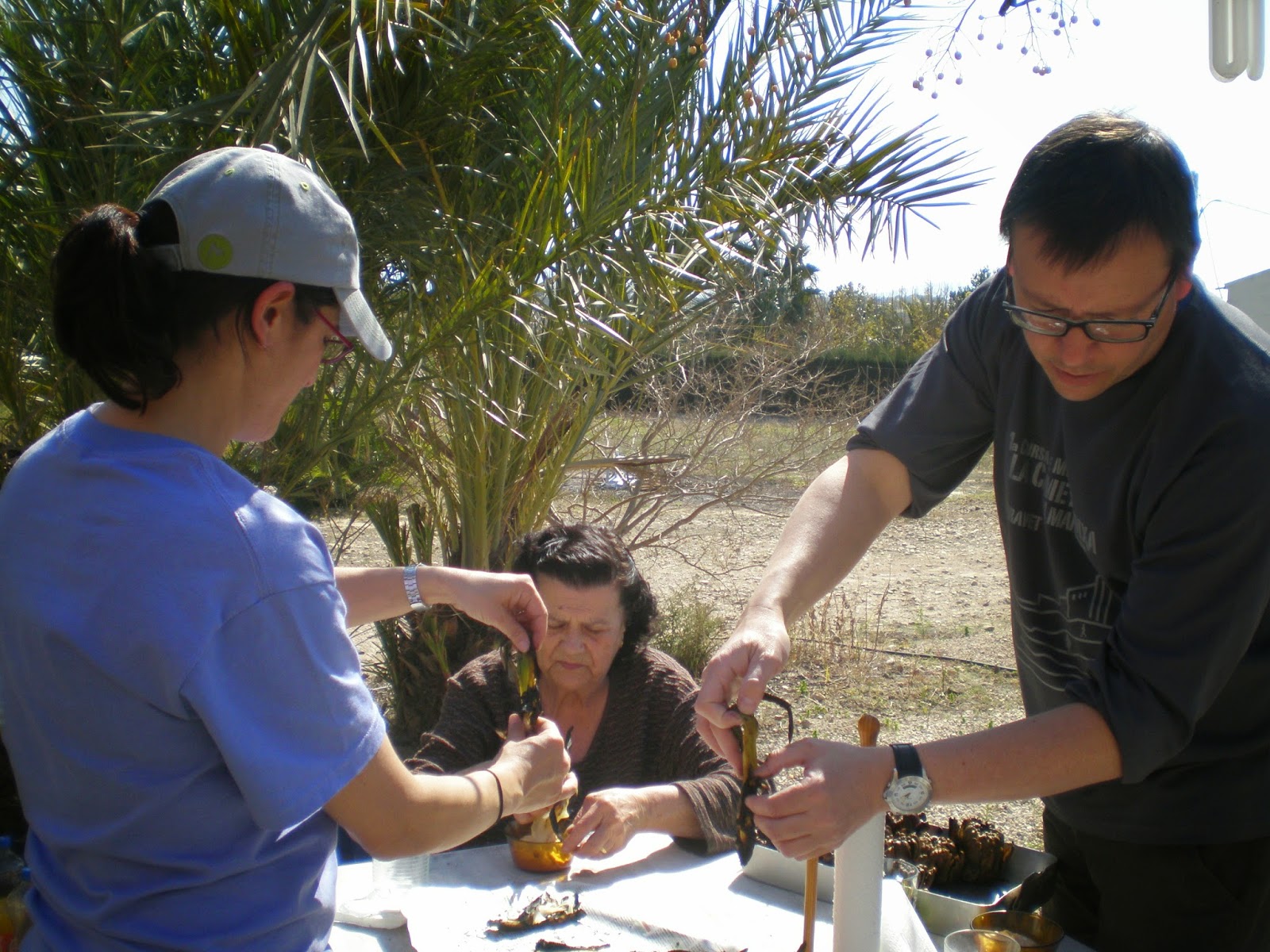
Now, you
usually all stand around a long table in the garden with a little dish of the
sauce in front of you, the wine on the table in a porrò (see photo below - designed
to pass around, pouring from the small hole directly into the mouth without
touching it (with your mouth)), and remember (too late now) you should be
wearing your don’t-care-if-I-make-a-mess clothes. Some less experienced calçot
feasters also wear bibs. It has been said that in the urban capital of
Barcelona they may even wear gloves but that’s nonsense ... the whole point is
to make a mess. Get a calçot, hold it up by the leaves and peel the burnt skin
down and off till you see the tender white calçot. Dip it in the sauce and hold
it above you, and gently bite away at the bottom. You may need a few bites and
a few sauce-dips to finish one, eating as far as the non-tender green leaves.
Then repeat. You will soon see the sauce and burnt stuff gets everywhere, a very dirty messy meal! It’s said
that a typical adult would eat about 10 of them. The calçots, and especially
the sauce, are delicious but don’t overdo it as once this part of the feast is
over, you tidy the table up a bit and dig in to all the other great stuff.
Usually a plethora of barbecued meat, roasted artichokes, a variety of omelettes,
olives, crisps, toast with allioli (like garlic mayonnaise, homemade also
before lunch), roasted red pepper and aubergine, wine and/or beer and so on.
When you’re well and truly stuffed you can sit around all day in the nice
Mediterranean winter sun, chatting away, and having a coffee, or get dragged
into doing games and sports by the kids who are usually fed up of just cooking
and eating by now.
As I’ve
said, difficult to reproduce this event in South Yorkshire or other places in
the world, but no winter-spring visit to Catalonia is complete without trying
one!
* The key
to the question – just what is a calçot? Well, according to different English
web pages or newspaper articles it could be a spring onion, a shallot, a
scallion, a green onion, a sweet onion, looks like a leek... whoah, wait a
minute! Having eaten many, I’d say it’s a kind of bland sweetish (i.e not really
cry-your-eyes-out onion flavoured) onion but the trick is not so much what dodgy translation we can find in a dictionary, but more in how it is grown. The farming technique and soil is key to producing the "calçot". As the onion starts to grow,
you pile the soil up around it, and again a few days later, and again, and so on. It’s a slow and careful
process (my father-in-law used to do it) but if you do it well, and the weather
is suitable, and the kind of soil right, eventually you get these long white 2
cm (?) thick “onions”. Try these links... Guardian , Wikipedia , another blog post on the subject by someone else.
Photos say more than a thousand words, they say...